
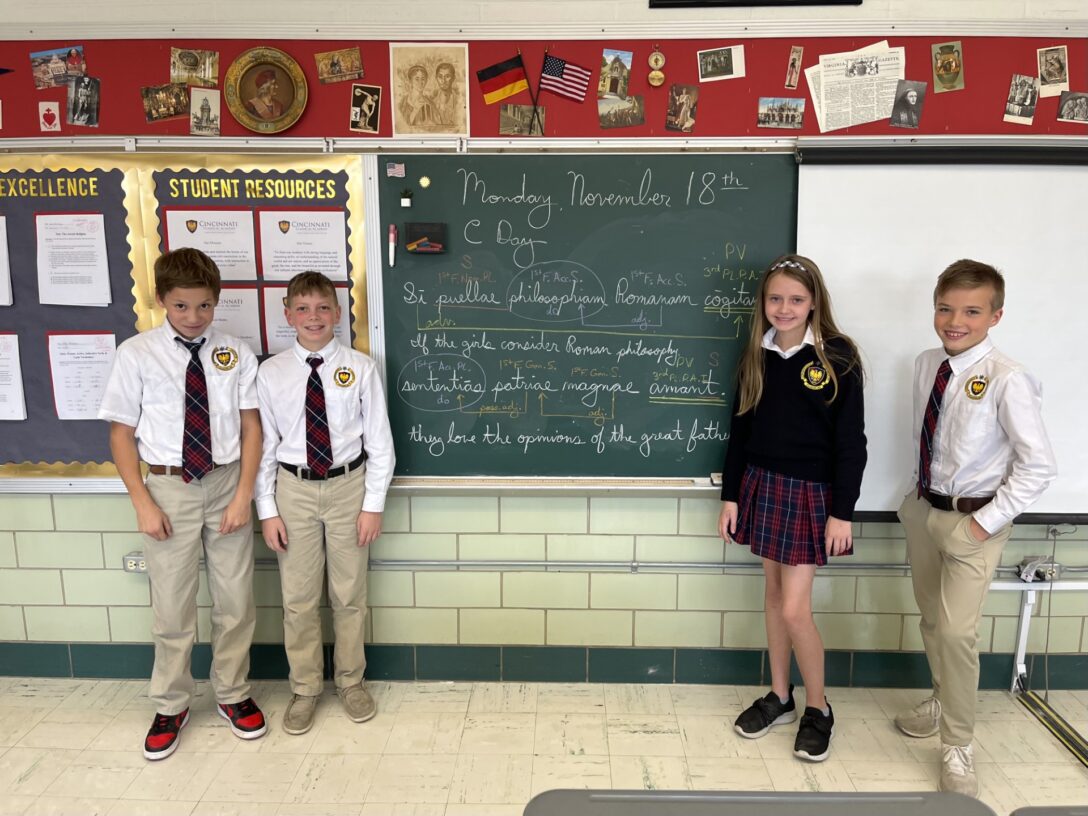
An enduring controversy among Latin teachers concerns the degree to which Latin instruction should be explicitly grammatical on one hand, or immersive on the other. Yet, certain pedagogical tools exist through which explicit Latin grammar can be “illuminated,” including the use of the method of sentence analysis employed by Dr. Dan Coupland’s “Well-Ordered Language” Series. Master Teacher Paul Mittermeier shares his thoughts in this post!
Among the questions most commonly raised by– and even debated among– Latin teachers is whether the Latin Language is better imparted to middle and high schoolers in a classical educational setting through an “immersive approach” or an explicitly “grammatical approach.” Whereas proponents of the former approach are quick to point out that language itself is best apprehended not through technical analysis of grammatical “nuts and bolts” but through actual “living” experience (that is, through conversation, engagement, and the use of the spoken word along with the written word), advocates of the latter approach rebut that, if the Trivial conception of education is at all to be believed, a prescriptive or didactic approach to grammar exercises a necessary, formative influence on the mind of the child, especially in the pertinently-named, early “grammar stage” of the child’s formation. Indeed, adherents of the former position maintain, the error of far too many Latin programs is the effective treatment of the language precisely as that of which it is most commonly accused by its detractors: namely, of being a “dead language,” or a determinate body of knowledge to be studied and analyzed rather than a living thing to be exercised. Yet, adherents of the latter position underscore, it is also true that frustrations with the “immersive” approach to English Grammar that predominated in the academy for the better part of the last century, together with a call to return to explicit grammar and phonics in the teaching of English, are among the chief impetuses of the ongoing “resurgence” of classical education; if the widespread abandonment of explicit grammatical formation seemed to adversely impact students’ apprehension of the English Language, they rightly ask, then why should this same phenomenon not also hold with respect to Latin?
Leaving aside this very worthy debate, which raises fruitful considerations in support of both positions and which underscores the need for Latin classrooms to be “well-rounded” and to purposefully incorporate both explicit grammar and immersive dialogue into the learning environment, that these two necessary elements of language might complement each other rather than contending in a “false dichotomy,” there exists one point of pedagogy that Latin teachers might do well to bear in mind while working to find a “harmony” between the explicit and the immersive: namely, that explicit grammatical instruction is not inherently “dry” or “unenchanting” as some fear, and that indeed, Hillsdale’s K-12 Curriculum is rich in elements which help to foster a love and an enthusiasm for grammar. Central among these elements is the method of sentence analysis and diagramming that elementary and middle school students undertake at Hillsdale’s K-12 schools using Tammy Peters’ and Dr. Dan Coupland’s Well-Ordered Language Series, which not only serves as a source of enthusiasm for students in its own right, but which also equips students for the analysis and parsing of Latin sentences more than one is initially inclined to appreciate.
Well-known for its repertoire of grammatically-themed songs, which teachers in Hillsdale’s schools find their students regularly singing even years after first learning them, Well-Ordered Language helps students to understand the fundamentals of English Grammar thoroughly and joyfully, enabling them to identify the principal and subordinate elements of English sentences with ease in order that they might “analyze” them using a very particular method of notation and “marking,” and, ultimately, diagram these sentences. In habituating themselves with this style of grammatical notation and its “order of operations,” students learn in time to approach each sentence first by identifying any conjunctions, which they mark inside a pair of out-turned brackets, and then by isolating any interjections, which they label in turn with “int.” Next, students mark prepositional phrases, which they place in parentheses, labeling each phrase’s preposition with “prep” and each object with “op,” accordingly linking each of these phrases to the nouns and verbs that they modify with an arrow below the text of the sentence, marking each arrow as “adj prep” or “adv prep” appropriately. This, then, permits them to go on to mark a series of other principal and subordinate elements, each with their own respective notations, including subjects, verbs of every and any variety, predicate nominatives and adjectives, adverbs, other adjectives, and so on. It is no secret that many students regard this notation system as “like a puzzle” and that, in their zeal to utilize it for the “dissection” of compound-complex sentences, they often request to analyze and diagram exceedingly long and challenging sentences from famous works of literature as a sort of “extracurricular” venture.
With respect to the teaching of Latin, the value of this system of grammatical analysis, which students undertake long before beginning to formally study ancient language, cannot be overstated, as it aids firstly and foremost in their understanding of grammatical elements that must be easily identifiable when students begin conjugation and declining. How much easier, for instance, it becomes for students to comprehend the uses of the Accusative and Ablative Cases for objects of prepositions when, because of Well-Ordered Language, they already possess a working knowledge of the difference between adjectival and adverbial prepositional phrases! Moreover, this notated method of analysis integrates easily with the traditional, grammatical practice of parsing, wherein students “mark” Latin sentences by indicating the person, number, tense, voice, and mood of finite verbs; the declension, gender, case, and number of nouns; and other such qualities and characteristics of principal and subordinate elements. A teacher’s “framing” of parsing as a sort of “Romanized extension” of Well-Ordered Language’s method of analysis not only communicates to students what this process entails from the outset, but also renders them all the more capable of completing it; thus, those students who already enjoy the analysis of English sentences will relish all the more in an even more detailed, comprehensive, and beautiful finished product.
In seeking to achieve the right “balance” between the explicitly grammatical and the immersive, then, Latin teachers might consider the use of Well-Ordered Language’s method of sentence analysis, in which the students they receive should already be well-versed, as a written and choral, pedagogical tool for the “illumination” of that which might otherwise be sterile; through it, teachers can certainly expect to “breathe new life” into Latin grammar, that is acts not as a source of drudgery, but of enthusiasm and enchantment.